
Repositioning marble as a strategic platform for experience, sustainability, and advanced applications
Natural stone is no longer merely a material—it is increasingly emerging as a platform for design, experience, and innovation.
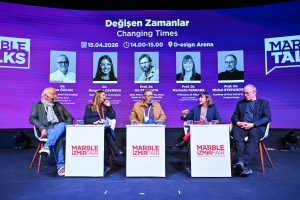
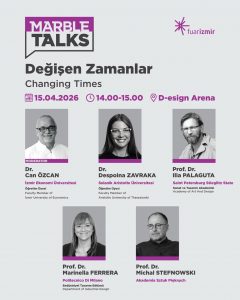
Within the framework of the Marble İzmir Fair, the Değişik Natural Stone Design Competition offered an important opportunity to reflect on this transformation. On this occasion, Marinella Ferrara participated as a jury member and contributed to the panel discussion “Changing Times,” addressing the evolving role of marble in contemporary design culture.
The competition, focused on innovative applications of natural stone in furniture and home accessories, highlighted how emerging designers are reinterpreting the material through new narratives and value systems, moving beyond conventional uses toward more experimental, design-led approaches.
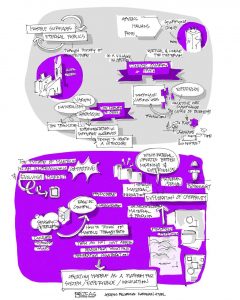
Rather than approaching marble as a static or purely extractive resource, Ferrara proposed a shift in perspective: from material to design-driven platform. In a context where engineered and artificial materials offer efficiency, predictability, and cost advantages, marble cannot compete on identical terms. Its distinctive value lies in its uniqueness, variability, and cultural depth—qualities that, when activated through design, can be transformed into strategic assets.

This shift also reflects an experiential transformation. Marble is no longer confined to visual or tactile attributes; it increasingly contributes to spatial and sensory systems—interacting with light, shaping atmospheres, and integrating with technological components. In this sense, it evolves from a surface into an active agent of experience.
Such transformations are already evident in contemporary practice. Companies such as Salvatori have redefined natural stone through surface design, creating textures that interact with light and generate spatial identity. Lithos Design has explored modular systems that combine geometry, repetition, and light to produce immersive environments. Lithea integrates craftsmanship, advanced processing, and design culture to develop highly customized, narrative-driven applications, where value resides in the designed outcome rather than in the raw material alone.

Image: design by Martinelli Venezia for Lithea
Technology plays a pivotal role in this evolution. Digital design tools, CNC machining, and robotic fabrication expand the expressive and functional possibilities of natural stone, enabling new geometries, optimizing material use, and supporting more sustainable production processes. Within this framework, sustainability is no longer a constraint but a driver of innovation, guiding the transition toward more efficient, circular, and responsible production models.
Within this evolving landscape, the role of the designer is also shifting—from shaping objects to orchestrating systems that connect materials, technologies, and users. The future of marble does not lie in competing with artificial materials, but in redefining its role through design—as a medium capable of generating value, meaning, and experience.

Ultimately, the question is no longer which material is superior, but which material is capable of generating greater value, meaning, and experiential quality through design.


